

Jenny Wren's Quick Guide to: VBAC
Congratulations!
When you find out you’re pregnant after a previous caesarean, it can be daunting and difficult to navigate your birth options. Almost certainly at your booking-in appointment you were told you were “high-risk” and immediately put under consultant-led care. Maybe you have attended consultant appointments and been told how you will be giving birth.
I wanted to write something to summarise the information I usually give mums planning their VBAC (Vaginal Birth After Caesarean) from my experience of supporting them. I will also be writing a guide to caesarean for those who decide this is the right option for them too.
VBAC is a safe and rational option and NICE guidelines state that women should be supported in this choice for up to 4 previous caesareans. Often mums are treated like one big walking risk, but I want to get specific….
What are the main risks?
What is not always explained to mums is that when they have a caesarean this impacts future pregnancies. One of the risks is placenta accreta where the placenta attaches abnormally into the womb and can increase the rate of haemorrhage and miscarriage. The other risk is placenta previa which is where the placenta covers the cervix. These risks increase with each caesarean.
The main risk usually talked about is scar rupture and this is the basis on which caregivers usually plan a mother’s labour for her. The risk of rupture is 0.5%, that is, 1 in 200. Of that 0.5%, 6% of those ruptures are considered “catastrophic”, which is to say, resulting in perinatal death.
Induction of labour may not be recommended as the synthetic oxytocin (syntocinon) may increase risk of rupture so it’s important to make a plan should you go “post-dates” whether you would prefer to have a planned caesarean section or try other methods of induction with their associated risks.
For these reasons caregivers usually recommend giving birth in a consultant-led unit and having continuous monitoring, as any variations in the baby’s heartbeat are early indicators that a rupture may occur.
What makes VBAC less likely to happen?
Continuous monitoring and being in a consultant-led unit both reduce the chance of a VBAC as they increase the risk of intervention. Currently there is no evidence that continuous monitoring improves outcomes over intermittent monitoring via Doppler. Continuous monitoring reduces the ability to move and have an active labour.
If you wish to have continuous monitoring, the alternatives are a fetal scalp monitor or wireless monitoring which would enable you to use a birth pool. However, the scalp monitor requires your waters to be broken (which is an intervention) and the wireless monitoring may not be reliable or caregivers may be reluctant to use it. You can request intermittent monitoring and a waterbirth on the consultant-led unit if a pool is available.
The chance of a successful VBAC in this setting is around 60-80%, which is about the same as the chance of any first time mum having a vaginal delivery.
What makes VBAC more likely to happen?
The rate of successful VBAC in a home setting has been reported to be as high as 90%. The benefits of being at home are that you have minimal risk of intervention and are in control. Some women make this decision based on how close they live to their local hospital if an emergency occurs.
Having a doula reduces the risk of caesarean section.
If you don’t want to give birth at home or on a consultant-led unit, a compromise may be a midwifery-led unit, or MLU. However, they do not usually accept VBAC and it is up to you to negotiate if that is where you would like to give birth. They may not say yes. You will need to make an appointment with your head of midwifery or consultant midwife and if necessary, get your birth plan agreed and signed so you do not have any problems on the day when you arrive in labour.
Your greatest asset will be a strong birth partner and advocate for when you are in labour to speak up for what you want when you may not be able to.
When negotiating - ask for facts, just like I have given you. Any emotional blackmail or incorrect information is unacceptable. If you decide that VBAC is right for you and you have anybody who is unsupportive, you are entitled to decline their care and request somebody else. Ask yourself - who prioritises the baby's safety more than the mother? Nobody. Your job is to make the decisions that are right for you and birth in the manner in which YOU feel safest.
Any additional risk factors beyond previous caesarean will need to be taken into account when making your decision. However, you can feel confident that VBAC is successful the majority of the time.
Remember this is YOUR body, YOUR baby and YOUR birth.
My Small Motherhood Achievement
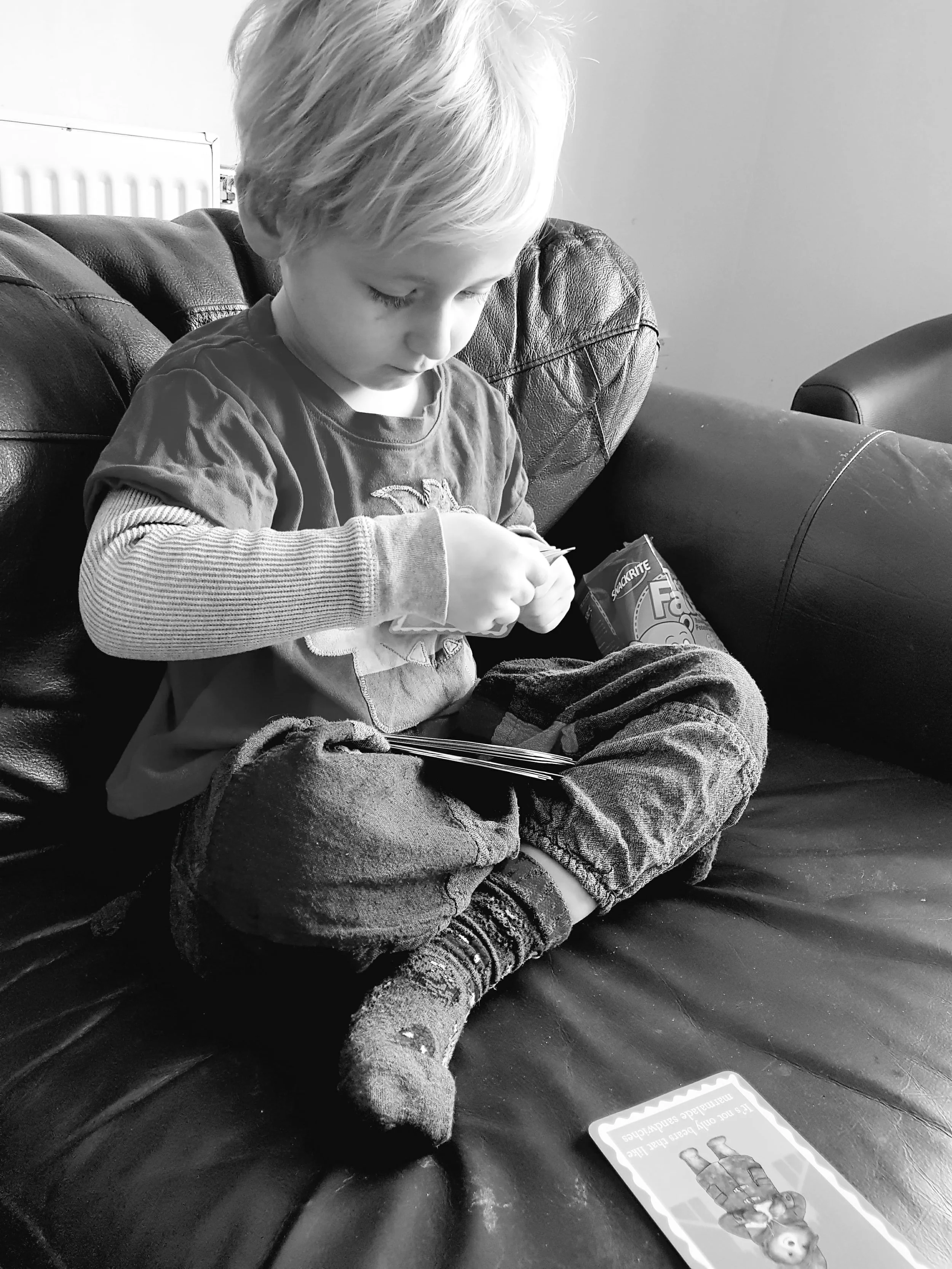
I think it was a birthday present. We didn’t manage to save them all but the Paddington Snap had been quickly stashed in my backpack where it slowly worked its way down to coexist alongside sand from last year’s summer, some socks and a bow-tie.
I haven’t been the most present mother lately and tensions are running high at home, with my boy determined to defy even the slightest instruction in his quest for autonomy, his desire to be heard. He is lonely, he is bored. He wants to play fight and most days I just long for peace and calm.
“Judah can you just—"
“Can you NOT"
“Please just—"
More often that not it is mummy who needs to be put in time out.
We were at baby group on Friday and yet again Judah was bored. He began to rifle through my bag, as he is wont to do, and out came the cards. Baby Violet was asleep in the sling so I found that I had time to play with him. I let him win a couple of times but he was pretty quick. I liked it when we were nearly the same speed and he ended up hitting my hand. I love his laugh.
He is such a traditional little child really, an Enid Blyton boy, who would love nothing more to be packed off for the day with a picnic and some jolly chums to play cards and have adventures.
I think he sensed that he had found a "way in" (he is so smart) and again today when the baby was napping and I sat down next to him on the sofa and there was no whining, no stroppiness, he simply asked if we could play Paddington snap.
I love the way he says Paddington snap.
I love the way he says he has sharp eyes to spot the match and furrows his brow.
I love the way he enunciates dramatically, putting emphasis in all the right places. He is a born performer.
I love the way he indignantly insists that he is paying attention after I win.
I love the way he marvels that there is a clock called BIG BEN.
I felt no frustration, only love.
There was eye contact, communication, jokes, good-natured competition. I marvelled at his humour and his charm.
It was then that I realised I have been so stressed about him not getting ‘quality time’. We go to soft play so he can burn off energy and I can work on my phone. We go to play dates so he can socialise with other children and I can vent to another mum. We run around everywhere on these insane errands and life admin. The game of snap took ten minutes. But he loved every second.
The vision in my head I have of ‘quality time’ tends to be us baking together, painting together, adventuring together, and a lot of the time is totally unrealistic. I will always fail and resent myself for it. I was allowing that resentment to bubble over and spoil any chance we ever had for connection.
The baby woke up and I popped her in her high chair, she is getting so big now… she is able to watch now...
What if quality time was pockets of ten minutes in an ordinary day where he gets undivided attention?
What if that was enough?
The guilt on my chest might lift and I might find that without that pressure I could feel more free to watch and enjoy the child I have in front of me, not the one in my head who is missing out on all the things I’m not giving him.
With small achievements comes confidence and I know this applies to most of our journey as parents. I remember the first time I took both children out together. I remember when I cracked doing bedtime with them both. It's the little things that seem insurmountable at the time.
So thank you to whoever gifted us the Paddington snap - I never knew how useful it would be!
When Rebel Girls Become Intuitive Mothers
I am young for a birth worker. I had my son when I was 22, having wanted a baby since I was about 16.
One thing that’s been swirling around my head for a while now, something I’ve noticed about my generation of girls that makes me infinitely proud - is how much we have reclaimed motherhood.
These are the women who twelve years ago were backcombing their hair, taking the first selfies, mixing vodka and energy drink behind city hall and stumbling home to their unsuspecting parents. Getting their first piercings in Blue Banana and stealing each other’s boyfriends and standing up for what they believed in.
And these girls became… mothers.
Who are not afraid to be different.
Along with rejecting conventionality we decided to reject leaving babies to cry. We rejected the idea that holding our babies would spoil them. Ideas that have to be explained with accompanying evidence to others, to tell them it really is okay, we seem to have intuitively understood. We would often choose to share our bed with our babies than a partner.
Seeing the beauty in birth from the women who spent hours in the tattooist's chair, who understand the idea of transformation through pain.
These women are fighting the older generation for their right to breastfeed their babies to natural term, often coming up against huge opposition and criticism. This shows exceptional strength of character.
These are the women fighting for their children's individuality to be respected, who want to find peaceful solutions and limit damage done.
Then the radical honesty that accompanies these friendships – women of my generation have never pretended to be okay, they acknowledge that days with little children are hard, but they’re committed to capturing the beauty too, in lives that have always been shared on social media.
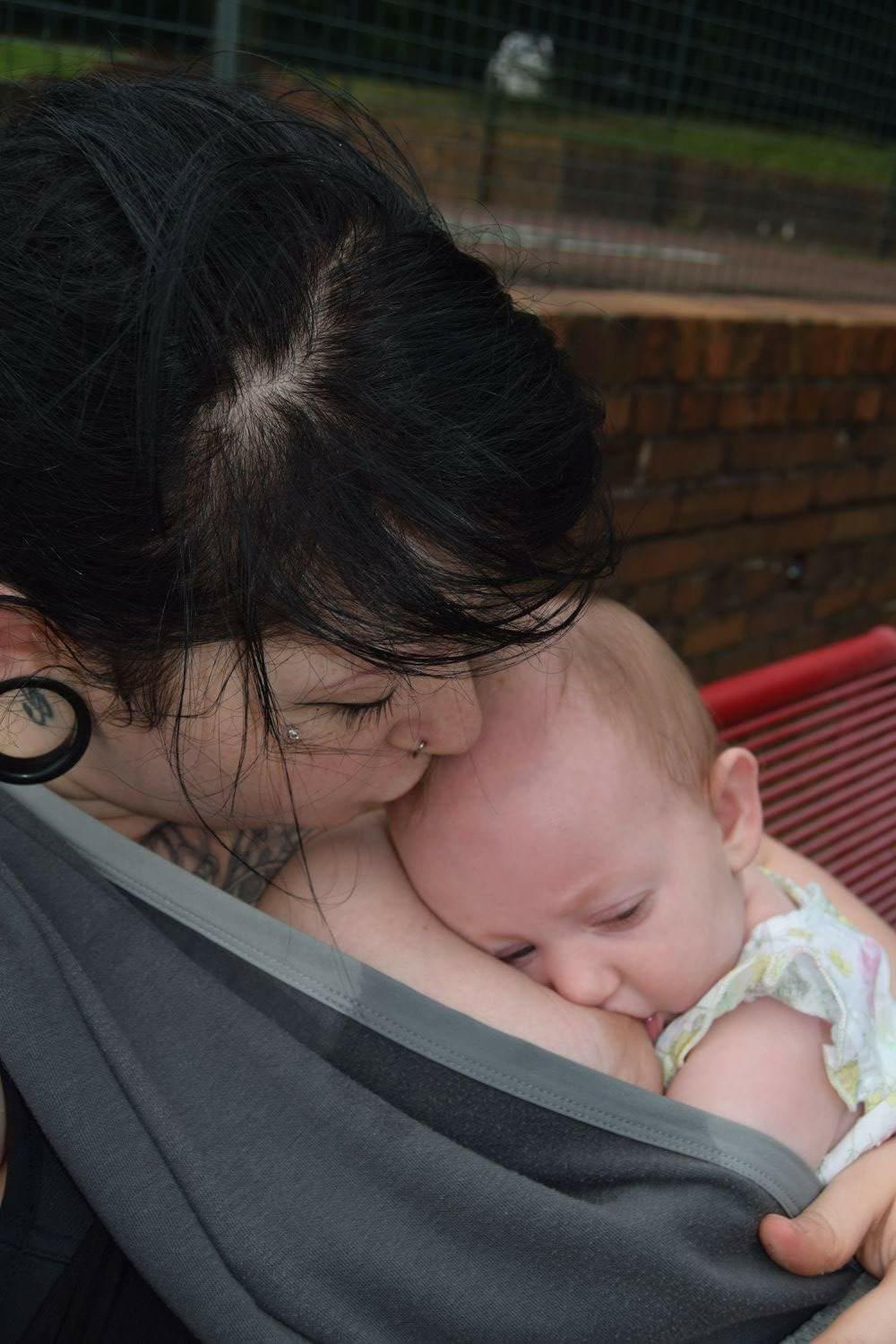
The beautiful baby carriers contrasted against tattooed skin.
I smile wryly as I think of the little babies whose mental image of ‘mama’ is skin a beautifully coloured canvas for little fingers to stroke, glossy hair tickling them as they feed and shining hoops in a smiling face. I wonder if they think that’s what women look like. I hope they do.
I’m so proud of these rebel girls who have embraced intuitive mothering. And I know that the best way to make them laugh is to ask them what their myspace name was.
